MIDUS Newsletters
We periodically create MIDUS newsletters and share them with our research participants. The newsletters provide summaries of some key findings that have resulted from the MIDUS study. (You will need Acrobat Reader to view them.)
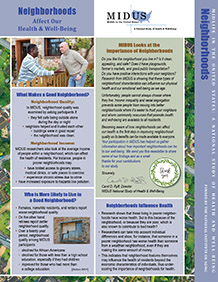 Neighborhoods Neighborhoods
MIDUS research is showing that the characteristics of the neighborhood in which we live can have significant effects on our physical health and psychological well-being.
.....learn more |
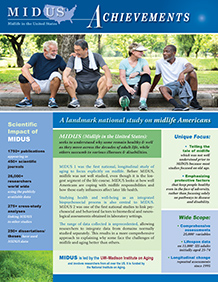 MIDUS Achievements 2022 MIDUS Achievements 2022
This special report celebrates almost 30 years of MIDUS contributions to the science of aging, and looks forward to the next 6 years of the study funded by the National Institute on Aging.
.....learn more |
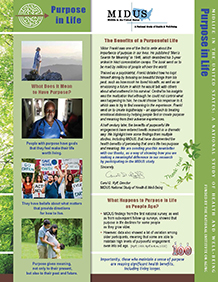 Purpose in Life Purpose in Life
This newsletter is about the significant health benefits that are associated with feeling that your life has purpose and meaning.
.....learn more |
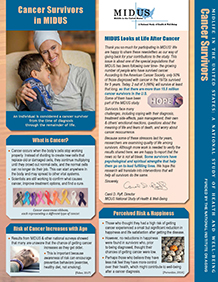 Cancer Survivors in MIDUS Cancer Survivors in MIDUS
This newsletter is about one of the special populations MIDUS has been following- the growing number of people who have survived cancer.
.....learn more |
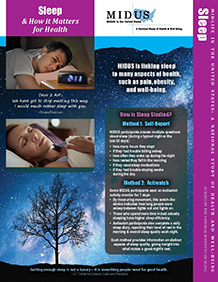 Sleep & How It Matters for Health- Sleep & How It Matters for Health-
MIDUS is linking sleep to many aspects of health, such as pain, obesity, and well-being
.....learn more |
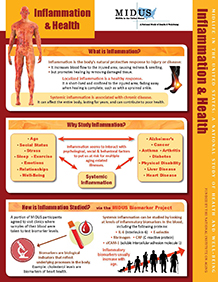 Inflammation & Health- Inflammation & Health-
Inflammation seems to interact with psychological, social & behavioral factors to put us at risk for multiple aging-related illnesses
.....learn more |
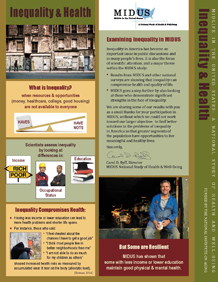 Inequality & Health- Inequality & Health-
Inequality in America has become an important issue in public discussions and in many people's lives. It is also the focus of scientific attention and a major theme within the MIDUS study.
.....learn more
|
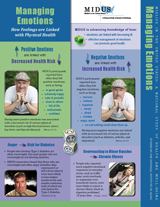 Managing Emotions- How Feelings are Linked with Physical Health Managing Emotions- How Feelings are Linked with Physical Health
MIDUS is advancing knowledge of how emotions are linked with becoming ill, and how effective management of emotions can promote good health.
.....learn more
|
 Employment Affects
Our Health & Happiness Employment Affects
Our Health & Happiness
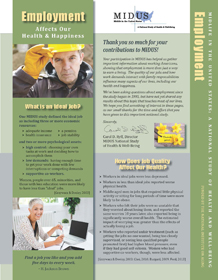
What is an ideal job, how does combining work & family affect our health, does career success buy happiness? MIDUS data on employment is used to explore a topic that touches most of our lives.
.....learn more
|
 MIDUS Goes Forward 2013 MIDUS Goes Forward 2013
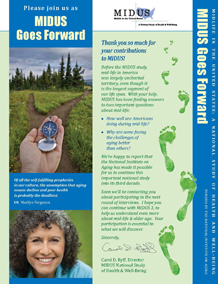
We're happy to report that this important national study is continuing into its third decade. We hope past participants will continue with MIDUS 3 and help us understand even more about midlife and older age in the US.
.....learn more
|
 Volunteering - Does it Help Us as We Age? Volunteering - Does it Help Us as We Age?
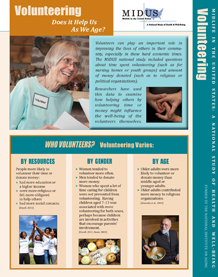
Researchers have used MIDUS data to examine how helping others by volunteering time or donating money might influence the well-being of the volunteers themselves.
.....learn more
|
 The Long Reach of Childhood Experiences The Long Reach of Childhood Experiences
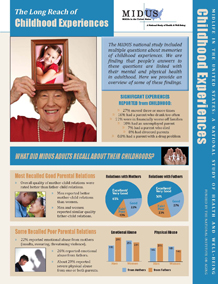
MIDUS included multiple questions about memories of childhood experiences. We are finding that people's answers to these questions are linked with their mental and physical health in adulthood.
....learn more |
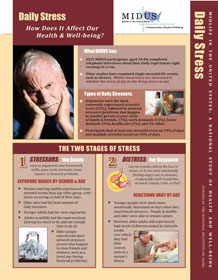 Daily Stress- How Does it Affect Our Health & Well-being Daily Stress- How Does it Affect Our Health & Well-being
Some MIDUS participants completed telephone interviews about their daily experiences eight evenings in a row. MIDUS researchers are interested in whether the stress of day to day living wears us out.
..... learn more |
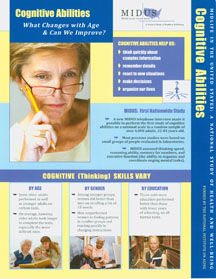 Cognitive Abilities - What Changes with Age & Can We Improve? Cognitive Abilities - What Changes with Age & Can We Improve?
Cognitive abilities help us think quickly about complex information, remember details, react to new situations, make decisions, and organize our lives.
.... learn more |
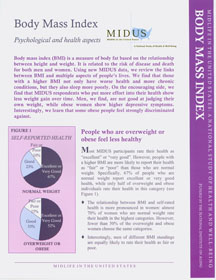 Body Mass Index - Psychological and Health Aspects Body Mass Index - Psychological and Health Aspects
Using new MIDUS data, we review the links between BMI and multiple aspects of people's lives.
.....learn more |
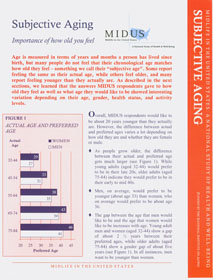 Subjective Aging - Importance of How Old You Feel Subjective Aging - Importance of How Old You Feel
The answers MIDUS repondents gave to how old they feel as well as what age they would like to be, showed interesting variation depending on their age, gender, health status, and activity levels.
....learn more |
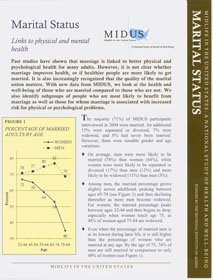 Marital Status - Links to Physical and Mental Health Marital Status - Links to Physical and Mental Health
With new data from MIDUS, we look at the health and well-being of those who are married compared to those who are not.
....learn more |
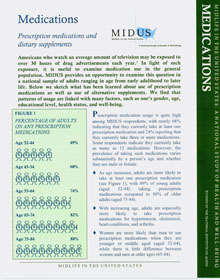 Medications - Prescription Medications and Dietary Supplements Medications - Prescription Medications and Dietary Supplements
We find that patterns of medication usage are linked with many factors, such as one's gender, age, educational level, health status, and well-being.
.....learn more |
|
|

